Toughened glass: roller waves, spots and other things that are not defects
Toughened glass is stronger and safer, but toughening leaves traces that ordinary glass does not have. The most common question is about waves in reflections. Here is what is normal, what the standard says and how to choose glass so that it shows as little as possible.
Roller waves: where they come from
During toughening the glass travels through the furnace on rollers. At the end of heating it softens and rests on them, sagging very slightly between the rollers. Rapid air quenching “freezes” that shape. These are roller waves. Every toughened pane has them; the only difference is how much.
You do not see them looking through the glass, only in reflections: the straight line of a neighbouring building, a column or a roof edge looks slightly wavy in the glass.
EN 12150-1 allows at most 0.3 mm over 300 mm, measured at least 25 mm from the edge. The straight edge rests on the wave crests and the gap down to the bottom of the trough is measured. Glass within these limits is compliant.
When the waves show more
- glass with a reflective or darker coating, because it reflects more
- a dark room behind the glass
- large panes and façades, seen from outside at a sharp angle
- an insulating unit with two toughened panes: two reflections, two waves
- thin glass in a large size
What helps
Thicker glass for larger sizes. Because of the toughening process, the recommended minimum thickness by pane size is:
| 4 mm | up to 1000 × 2000 mm |
| 5 mm | up to 1500 × 3000 mm |
| 6 mm | up to 2100 × 3500 mm |
| 8 mm | up to 2500 × 4500 mm |
Spots and rainbows (anisotropy)
During quenching, air is blown through nozzles. Where the glass is cooled slightly harder, small stress differences remain. Under polarised light they show as rows of spots or stripes in rainbow colours: through polarised sunglasses, with blue sky in the reflection, or in raking light.
EN 12150-1 explicitly describes this as a visible effect of toughening, not a defect. Every toughened pane has it, but it is not always visible.
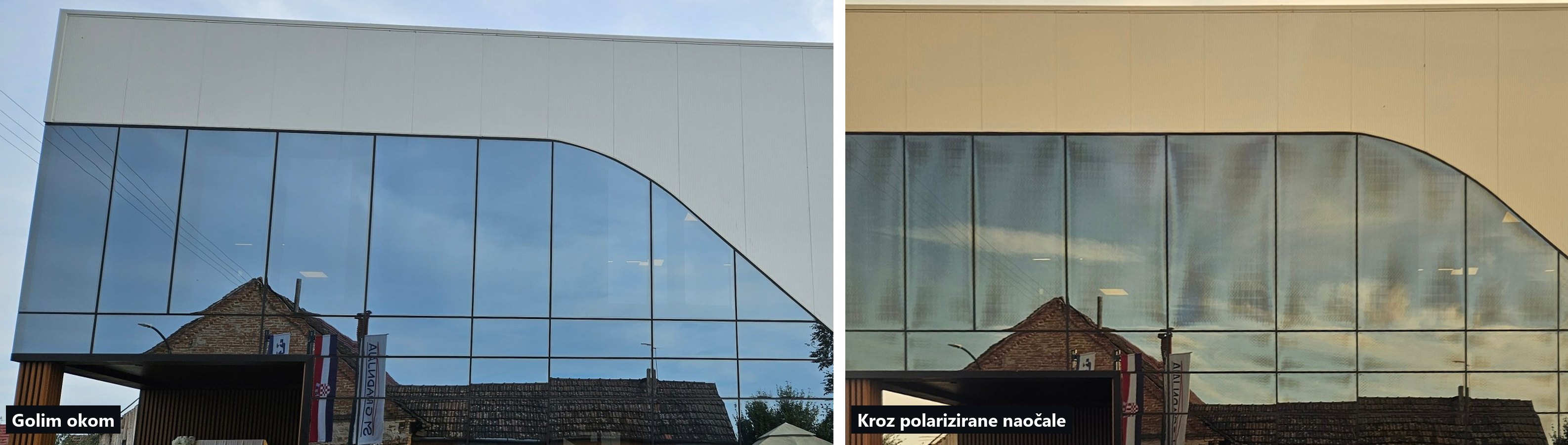
Slight bow
Toughening stresses can bow the glass slightly. At most 3 mm per metre (0.3 % of the length) is allowed, measured along the edges and the diagonals. Nearly square panes thinner than 6 mm naturally bow a little more.
Marks when the glass mists up
Rollers, suction cups and glazing compounds leave an invisible trace on the surface. When the glass mists up, water spreads differently on those spots and the marks show for a moment. Once the glass is dry, they disappear. Not a defect.
Rare spontaneous breakage
A tiny nickel sulphide particle in the glass can grow after installation and the toughened pane breaks without impact. It is rare, but it does happen. HST (heat soak test) reduces the risk. More on the Toughened glass page.
The mark in the corner
Every toughened pane must carry a permanent mark. It shows that the glass is toughened even after installation, which matters for doors, balustrades and shower enclosures.
In short: waves in reflections, spots under polarised light and marks when the glass mists up are properties of toughened glass. For large panes, choose thicker glass.
Send us your opening schedule
or a project brief.
We reply with a quote and a technical data sheet, and on request a specification clause for your bill of quantities.